
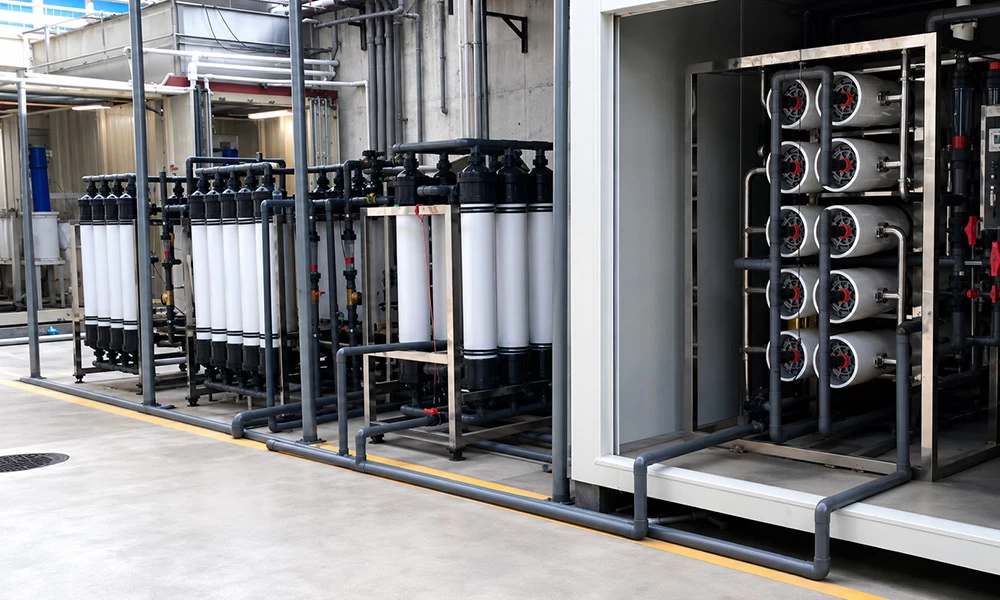
Quick answer: Water treatment equipment capacity is not a single number you read off a catalogue. A system rated at "10 m³/h" describes throughput at one set of assumed feed-water conditions. The figure that actually sizes your project is the required treated-water quality at the required flow under your raw water analysis. Two projects with identical flow requirements can need systems that differ by a factor of two in membrane area and pretreatment complexity.
Why the capacity number on a quotation is not the whole specification
When a quotation lists "RO pure water equipment, 5 m³/h", that number is a design point. It assumes a particular feed-water total dissolved solids (TDS) level, a particular temperature, a particular recovery rate and a particular target permeate quality. Change any one of them and the same nominal capacity requires different membrane area, different pump pressure and a different pretreatment train.
The practical consequence: comparing two quotations on the flow number alone tells you almost nothing. What determines whether a system delivers your required water is the relationship between four variables.
The four variables that determine real system size
Every water treatment specification resolves to a balance between feed-water quality, target product quality, required flow and operating conditions. These cannot be selected independently.
| Variable | What it changes | Typical effect on system size |
|---|---|---|
| Feed-water TDS and composition | Osmotic pressure, scaling and fouling tendency | Higher TDS raises required pressure and lowers recovery, increasing membrane area and pump rating |
| Target product quality | Whether RO alone is sufficient or EDI/polishing is required | Ultrapure requirements (< 0.1 µS/cm) add an EDI stage and stricter pretreatment |
| Required flow rate | Membrane count, vessel arrangement, pump curve position | Flow is the multiplier, but its effect is not linear once recovery changes |
| Feed-water temperature | Membrane flux and salt passage | Cold water (below 10 °C) can cut effective capacity substantially at constant pressure |
A fifth factor sits outside the table but decides most marginal cases: how the plant actually operates. A system specified for 24-hour continuous duty at steady flow behaves differently from one that starts and stops several times a day. Intermittent operation drives more frequent flushing cycles, more thermal cycling of membranes and different storage requirements. This is the variable most often left out of a specification and most often responsible for underperforming installations.
Why raw water analysis must come before equipment selection
The single most common cause of a system that meets its flow rating but fails to meet water quality is a specification written without a complete raw water analysis. A partial analysis — typically just TDS and pH — omits the parameters that govern pretreatment design.
A specification-grade analysis should cover:
- Ionic composition: calcium, magnesium, sodium, potassium, bicarbonate, sulfate, chloride, nitrate, fluoride
- Scaling and fouling indicators: hardness, silica, iron, manganese, barium, strontium
- Organic and biological load: TOC, COD, turbidity, SDI15, bacterial counts
- Operational context: seasonal variation, temperature range, and whether the source is municipal, surface, well or a process effluent
Iron and manganese deserve particular attention. Even at concentrations that pass a general water-quality check, dissolved iron will oxidise and foul membrane surfaces, and it cannot be removed reliably by antiscalant dosing alone. If the analysis shows iron above trace levels, an oxidation-and-filtration pretreatment stage is a design requirement rather than an option — and discovering this after installation is expensive.
Process selection: matching the train to the application
Once feed water and product requirements are known, process selection becomes comparatively mechanical. The table below maps the main industrial and municipal requirements to the process trains that typically serve them.
| Application | Typical product requirement | Process train |
|---|---|---|
| Boiler feed water | Low hardness, low conductivity | Multimedia filtration → softening → RO (→ mixed-bed or EDI for higher pressure boilers) |
| Pharmaceutical / medical purified water | Conductivity and microbial control | Pretreatment → RO → EDI → UV / ultrafiltration polishing |
| Electronics and semiconductor ultrapure water | Trace ionic and organic control | Multi-stage pretreatment → double-pass RO → EDI → polishing loop |
| Bottled water and beverage | Consistent mineral profile, microbiological safety | Filtration → RO or blending → UV / ozone disinfection |
| Industrial wastewater reuse | Discharge compliance or reuse standard | Physicochemical treatment → biological treatment → ultrafiltration → RO |
| Municipal and commercial sewage | Discharge standard compliance | Integrated biological treatment (A/O or MBR) → disinfection |
The distinction that matters most in this table is between removing dissolved solids (membrane processes) and removing suspended and biological material (filtration and biological treatment). Many wastewater reuse projects fail not because the RO stage is undersized but because the upstream biological and ultrafiltration stages do not deliver feed water clean enough for the membranes to operate as designed. Membrane fouling is almost always an upstream problem.
What to specify before requesting a quotation
A quotation is only as good as the specification behind it. Providing the information below allows an equipment supplier to size a system that will actually perform, rather than one that matches a flow figure and leaves the quality risk with the buyer.
- Complete raw water analysis — full ionic composition, not only TDS and pH, with seasonal variation if the source is surface water
- Required flow rate and operating pattern — average and peak demand, hours per day, whether storage is available
- Required product quality with the standard it must meet — conductivity or resistivity target, and the applicable standard or internal specification
- Supply conditions — available power supply phase and capacity, feed-water pressure and temperature range, ambient conditions
- Site constraints — available footprint, indoor or outdoor installation, drainage, chemical storage and dosing space
- Reject-stream obligations — where concentrate will go, and any discharge limits that apply to it
Projects that supply all six items at the enquiry stage typically receive comparable quotations that can be evaluated on engineering merit. Projects that supply only a flow number receive quotations that cannot be compared, and the differences between them typically surface during commissioning.
Have a raw water analysis and a target flow? Send both to Mingtao's engineering team and we will propose a process train matched to your water quality and site conditions — including capacity configuration, pretreatment selection and equipment list, at no cost before order. Foshan Mingtao Environmental Protection Equipment Co., Ltd. designs, manufactures and installs water purification, wastewater treatment and water reuse systems for industrial, municipal and commercial projects.
Frequently asked questions
How do I know what capacity my project actually needs?
Start from peak demand, not average demand, then apply the required operating hours. If your plant uses water unevenly across a shift, the treatment system either has to be sized for the peak or you need treated-water storage sized to buffer the difference. Storage is often cheaper than capacity, but it must be sized on the actual daily profile rather than a rule of thumb.
Can I increase capacity later by adding membrane modules?
Sometimes, but rarely as simply as it sounds. Adding to a membrane array changes the flow and pressure balance across the whole system, and the existing high-pressure pump and pretreatment train must be able to support the additional load. If future expansion is likely, say so at the specification stage — designing for a modular increase from the outset is far less costly than retrofitting it.
Why does my RO system produce less water in winter?
Membrane flux depends on temperature. As feed water cools, viscosity rises and the same applied pressure produces less permeate. A system designed for 25 °C feed water can lose a significant fraction of its rated output at 5 °C. Either the design must account for the coldest expected water temperature, or a feed-water heater must be included.
What is the difference between pure water and ultrapure water equipment?
Pure water typically refers to RO-treated water used for processes such as boiler feed or general production, with conductivity in the tens of µS/cm range. Ultrapure water is produced by adding ion exchange or EDI after RO, and reaches resistivity in the 18 MΩ·cm range with tightly controlled organic and bacterial content — required for electronics, semiconductor and pharmaceutical applications.
What information do you need to quote a wastewater reuse system?
The most important input is a full analysis of the wastewater itself: COD, BOD, suspended solids, oil and grease, heavy metals, and pH range. Also useful are the required discharge or reuse standard, daily and peak volumes, and whether the source is a single process stream or a mixed plant effluent. Mixed streams with fluctuating composition usually need equalisation before treatment.
